Why Your Waterproof Jacket Works in a Downpour and Fails in Drizzle
Quick Answer: A waterproof membrane moves your sweat outward as vapour, and that only works when there is a moisture gradient — drier, cooler air outside than in. Heavy rain usually comes with a temperature drop and wind, which drives that gradient hard. Mild drizzle is warm and close to saturated, so the vapour has nowhere to go, and the water on your skin is your own. Same jacket, opposite result. You did not get wet from outside; you got wet from inside.
It is the single most misdiagnosed piece of running kit failure.
And it explains why people return jackets that were working exactly as designed.

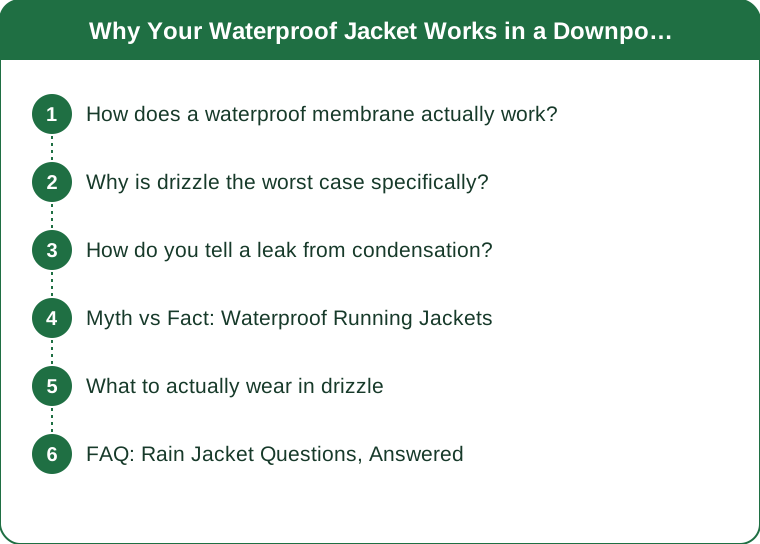
How does a waterproof membrane actually work?
By exploiting a difference in vapour pressure between the two sides.
A modern waterproof breathable membrane has pores — or a solid hydrophilic structure — that liquid water cannot pass but water vapour can. Sweat evaporates off your skin, becomes vapour, and moves through the membrane to the outside.
But vapour only moves in one direction for a reason: it travels from high concentration to low concentration. Inside your jacket, the air is warm and humid. If the air outside is cooler and drier, there is a strong gradient and the vapour leaves quickly. If the air outside is warm and already near saturation, the gradient is weak or nonexistent, and the vapour simply stays where it is.
Membrane breathability ratings — the numbers you see quoted in grams per square metre per 24 hours — are measured under standardised laboratory conditions with a specific gradient. They tell you what the fabric can do under favourable conditions, not what it will do on a humid September morning.
Why is drizzle the worst case specifically?
Because it combines every unfavourable condition at once.
Warm air. Drizzle typically arrives with mild temperatures, often 12 to 18°C. Your jacket is trapping heat you do not need, so you sweat more.
High humidity. Persistent light rain means the air is at or near saturation. The gradient the membrane depends on has effectively vanished.
Low wind. Wind is one of the main things that carries vapour away from the outer face of the fabric. Drizzle days are often still.
Wetted-out face fabric. This is the subtle one. The outer fabric of a waterproof jacket is treated with a durable water repellent finish so that water beads off. When that finish wears — and it wears with every wash and every mile — the outer fabric absorbs water and saturates. A saturated face fabric blocks vapour transfer almost completely, even though the membrane underneath is still perfectly waterproof.
So you have maximum sweat production and minimum vapour escape, at the same time. Ninety minutes later the inside of the jacket is wet and it looks exactly like a leak.
How do you tell a leak from condensation?
Three checks, and they are quick.
Where is the wetness? A leak appears at seams, zips, and cuffs — specific points. Condensation appears across the whole inner surface, most heavily on the chest, back and upper arms where you generate the most heat.
Is it warm or cold? Condensation from your own sweat is warm and slightly slick. Rain that has come through is cold.
Does the outer bead? Splash water on the shoulders. If it beads and rolls off, the finish is intact and any interior wetness is yours. If it soaks in and darkens the fabric, the outer has wetted out — which is not a leak either, but it does explain the interior moisture.
The honest conclusion in most cases is that the jacket is fine. The great majority of running jackets that people describe as having failed have either wetted-out face fabric or are simply being worn in conditions where no membrane could have kept up.
Which means the fix is usually maintenance or a different choice of layer, not a new jacket.

Myth vs Fact: Waterproof Running Jackets
Myth: A more expensive membrane would have kept you dry in drizzle.
Fact: No membrane can move vapour without a gradient. In warm, still, saturated air, the best jacket in the world breathes very little. Price buys you better performance in the conditions where breathing is possible, not a way around physics.
Myth: You should never wash a waterproof jacket, because it damages the coating.
Fact: The opposite. Body oils, salt and dirt on the face fabric are a leading cause of wetting out. Washing with a technical cleaner and reactivating the finish with low heat in a tumble dryer or a warm iron through a cloth genuinely restores performance.
Myth: Pit zips are a gimmick.
Fact: In warm, humid conditions, mechanical ventilation is doing far more work than the membrane. Pit zips, a two-way front zip, and a vented back are the features that matter most for drizzle running.
Myth: Water-resistant is always worse than fully waterproof.
Fact: For running in mild drizzle, a lighter water-resistant windshell is very often the better choice. This is the point that surprises people most — the less waterproof garment leaves you drier, because the water you are fighting is your own.
What to actually wear in drizzle
Match the layer to the failure mode.
Mild drizzle, 12 to 18°C: a water-resistant windshell or even just a long-sleeve technical top. You will get damp from the rain and it will not matter, because you are warm and moving. A full waterproof will leave you wetter.
Cool rain, 5 to 12°C: this is where a waterproof earns its place. The gradient works, and staying dry matters for warmth.
Cold, heavy rain and wind: full waterproof, hood up. The conditions the jacket was designed for.
Warm heavy rain, above 18°C: minimal. A cap to keep rain off your face and nothing waterproof at all.
A few habits that help regardless:
- Start slightly cold. If you are comfortable at the door you are overdressed, and overdressing is what generates the sweat the jacket cannot clear
- Open the zip early, not when you are already wet
- Use the pit zips from the start rather than as a rescue
- A cap does more for comfort than a hood in light rain, and does not trap heat around your head
The general principle: in mild wet weather, aim to manage your temperature rather than to stay dry. Staying dry is not available, and chasing it makes you wetter.
FAQ: Rain Jacket Questions, Answered
How often should I reproof a running jacket?
When water stops beading on the shoulders — for a jacket used regularly, often every 10 to 20 washes. Wash with a technical cleaner first, then apply a wash-in or spray-on treatment and heat-set it as the instructions specify.
Does a higher breathability number mean I will stay drier?
In favourable conditions, yes. In warm, saturated air, the difference between a good and an excellent membrane is much smaller than the difference between having ventilation and not having it.
Why is my jacket wet inside at the end of a run but not during?
Because you stopped generating heat. While you run, vapour moves and some evaporation continues; when you stop, the air inside cools and the vapour condenses onto the inner surface all at once. That is normal, and it is why changing promptly after a wet run matters more than what you wore during it.
Is a poncho or a vest a real option?
A vest with a wind-resistant front and a mesh back is genuinely excellent for mild drizzle — it protects the core and vents everything else. It is an underrated piece of kit for exactly these conditions.
TL;DR:
- Membranes need a moisture gradient; warm, humid, still drizzle removes it entirely
- A worn water-repellent finish makes the outer fabric saturate, which blocks vapour transfer
- Condensation appears across the whole inner surface and feels warm; a leak appears at seams and feels cold
- In mild drizzle, a water-resistant windshell usually leaves you drier than a full waterproof
- Wash and reproof the jacket rather than replacing it
Before you decide a jacket has failed, splash some water on the shoulder and see if it beads. Most of the time the jacket is doing exactly what it was built to do — it is just being asked to do it on a day when nothing could.
Keep Reading
This article is for general informational and styling purposes only. Fit, sizing, and product availability may vary.