Why Running Between Showers Is Usually Worse Than Running In One
Quick Answer: Running in steady rain is a known problem you can dress for. Running between showers is an unknown one — you dress for dry, get caught wet, and the gap between showers is when wind is strongest and temperature drops fastest as the front passes. Committing to the rain usually produces a better run than waiting for a window that closes on you two miles from home.
You have been at the window for forty minutes. The radar shows a gap at four. At four you leave, and at four twenty it is raining harder than it was at three.
There is a reason this keeps happening, and it is not luck.

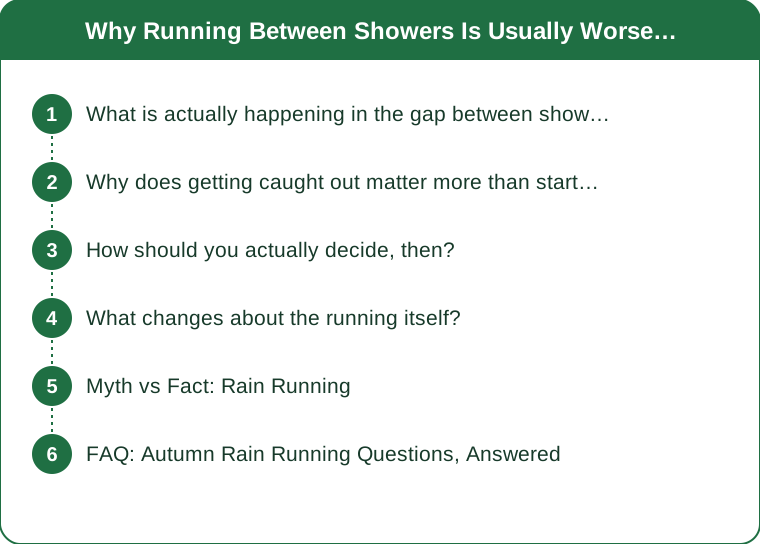
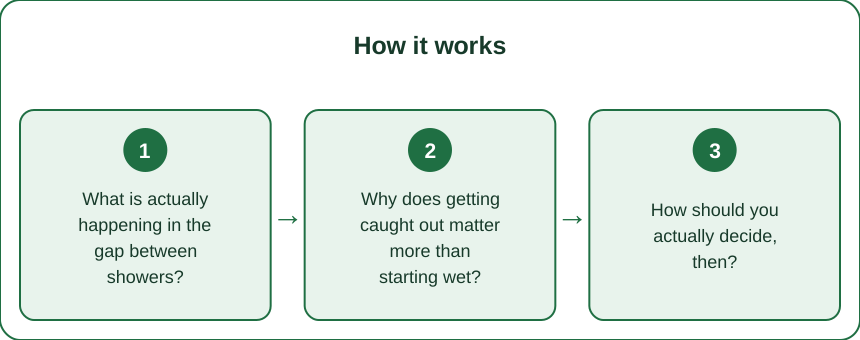
What is actually happening in the gap between showers?
The gap is not a calm period. It is the most unstable part of the whole system.
Showery autumn weather is driven by bands of instability moving through, and the space between the bands is where the atmosphere is doing the most work. Wind is typically strongest just before and just after a shower passes, not during the steady middle of one. Gusts swing direction as the cell moves through, which is why a run that started with a tailwind turns into a crosswind halfway.
Temperature moves too. A passing shower drags cooler air down with it, so the air behind the shower is often several degrees colder than the air in front of it. You dressed for the temperature you felt at the window, and by the time you are twenty minutes out you are in different air.
And the gaps are shorter than they look on a radar image. A rainfall map updates on a delay, shows a smoothed picture, and does not show the shower that is currently forming over the hill to the west. Radar tells you where rain has been more reliably than where it will be, and in showery conditions that distinction matters a great deal.
The steady-rain alternative is, oddly, more predictable. Frontal rain arrives, sits, and leaves on a schedule you can read. The wind is more consistent. The temperature is stable. You know exactly what you are dressing for from the first minute to the last, which is the single biggest advantage available in autumn running.
Why does getting caught out matter more than starting wet?
Because clothing that is dry when you start becomes a liability the moment it is not, and the reverse is not true.
If you start in the rain, you dress for wet. That means a base layer that moves moisture, no cotton anywhere, a jacket you have decided is worth its weight, and the mental acceptance that you will be damp. The whole system is designed for one condition and it holds up.
If you start dry and get caught, you are wearing the wrong system. The cotton t-shirt that was fine at the start is now holding half a litre of cold water against your skin. The jacket you left at home would have been useful. And because you did not plan for it, you are usually further from home than you would have been.
The temperature consequence is the part people underestimate. Wet clothing conducts heat away from the body far faster than dry clothing, and the effect scales sharply with wind. A wet layer in still air is uncomfortable; the same wet layer in a fifteen-mile-an-hour gust behind a shower is a genuine heat-loss problem, especially in the final miles when your pace and heat production drop.
There is a psychological component too, and it is not trivial. A run you chose to do in the rain is a different experience from a run the rain did to you. The first one is a decision you feel good about. The second is forty minutes of low-grade irritation that makes you less likely to go out next time. Over a season, that difference in willingness matters more than any single session.
How should you actually decide, then?
Read the type of rain rather than the probability, and treat the decision as binary.
Steady, light-to-moderate rain at moderate temperature is a good run. Dress for it properly and it is often one of the better sessions of the month — quiet paths, cool air, no overheating. This is the condition people avoid unnecessarily.
Showery conditions with gaps are the ones to dress defensively for. If you are going out in a gap, dress as if it will rain, because it probably will. That means taking the jacket you would rather not carry. Being slightly over-dressed in a gap costs you very little; being under-dressed when the gap closes costs you the rest of the run.
Heavy rain with wind and cold is the one to move or shorten. There is a real threshold where the combination stops being character-building and starts being a heat-loss problem, particularly on longer runs where your pace will drop in the second half. Below roughly ten degrees, with rain and meaningful wind, a long slow run is a poor choice and a shorter, faster one is a much better one.
Thunder is not a judgement call. Go inside.
The practical routing change that helps most: in unsettled weather, run loops close to home rather than out-and-backs. A four-times-around-the-park session is less interesting and means you are never more than eight minutes from a door. In showery autumn weather that is worth more than the scenery.

What changes about the running itself?
More than the clothing conversation suggests, and mostly in the second half.
Your pace will drift slower and that is correct. Wet ground, heavier clothing and more careful footing all cost energy, and fighting to hold your dry-weather pace turns an easy run into a moderate one without any benefit. Run by effort in the wet, always.
Footing is the real constraint, and it is worst in the first twenty minutes of rain after a dry spell. Oil and dust lift off road surfaces and sit on top of the water, which is exactly the condition that catches people on painted lines, metal covers and smooth stone. After an hour of rain the surface is actually cleaner and grippier than it was at the start.
Corners and downhills are where wet-weather falls happen, not on the flat. Widening your line into corners and shortening your stride on descents costs a few seconds and removes almost all of the risk.
Your body cools much faster the moment you stop. This is the most consistently underestimated part of wet running. You finish, feel fine, stand around for five minutes, and then get cold in a way that takes an hour to undo. The rule is to get changed immediately — not after stretching, not after checking your watch splits, immediately.
And the smaller things that only matter when wet: seams rub more, so anywhere that chafes occasionally will chafe reliably; wet socks produce blisters far faster than dry ones on the same distance; and a peaked cap is the single most useful item for keeping rain out of your eyes, which is a bigger quality-of-life factor than any jacket feature.
Myth vs Fact: Rain Running
Myth: A waterproof jacket keeps you dry on a run.
Fact: It keeps rain out and traps your own sweat in, and on a hard effort the second one wins. Most runners end a rainy run wet regardless — the question is whether they are wet with warm sweat or cold rain, and a good jacket controls that trade rather than eliminating it. Breathability and venting matter more than the waterproof rating for anything above easy pace.
Myth: You will catch a cold from getting wet.
Fact: Colds are viral and you get them from viruses. Being cold and wet is unpleasant and can be genuinely dangerous in the right conditions through heat loss, which is a different and more serious problem than a runny nose. Dress for the heat loss, not for the folk belief.
Myth: Wet roads are most slippery during heavy rain.
Fact: The most slippery period is the first ten to twenty minutes of rain after a dry spell, when surface contaminants are lifted but not yet washed away. Heavy sustained rain is grippier than a light first shower, which is the opposite of what instinct suggests.
Myth: You should always take the waterproof, just in case.
Fact: Carrying a jacket you never wear on every run has a cost in comfort and in willingness to go out at all. In steady predictable rain at mild temperature, no jacket is often the better call — a technical long sleeve that keeps working when wet does more good than a shell that makes you sweat.
Myth: Stuffing wet shoes with newspaper is an old wives’ remedy.
Fact: It works, because it moves moisture out by contact rather than waiting for evaporation. What does not work is a radiator, which dries the upper fast and degrades the midsole and adhesives while it does it.
FAQ: Autumn Rain Running Questions, Answered
How cold is too cold to run in the rain?
There is no fixed number, because wind and duration matter as much as temperature. A useful practical rule: below about ten degrees with rain and noticeable wind, shorten the run and raise the intensity slightly rather than doing a long easy one. The risk is in the slow final miles, not the fast early ones.
Do I need waterproof shoes?
Usually not. Water gets in at the ankle regardless, and waterproof uppers then hold it in. A normal shoe that drains and dries is generally the better choice for road running in the rain, with the exception of very cold conditions or deep standing water.
What is the best single item to own for rain running?
A peaked cap. It is cheap, it weighs nothing, and keeping rain out of your eyes changes the experience more than any expensive garment does.
Should I change my route when it is wet?
Yes, in two ways: prefer loops near home over long out-and-backs, and avoid trails or unpaved sections that turn into mud, since wet mud running is a different sport with a different injury profile. Painted road markings and metal covers deserve a wide berth.
My shoes never dry between runs. What now?
Two pairs alternated is the real answer, and it also extends the life of both. Short of that, remove the insoles, stuff loosely with newspaper, change the paper after an hour, and keep them somewhere with moving air rather than somewhere hot.
Is running in the rain bad for my joints or muscles?
The rain itself is not the issue; the surface and the cooling are. Wet, uneven ground raises the odds of a slip, and cooling down too fast afterwards can leave you stiff. Warm up properly, run by effort, and change clothes immediately at the end. Any pain that persists is worth a professional opinion. This is general information, not medical advice.
TL;DR:
- The gap between showers has the strongest wind and the fastest temperature drop — it is the least stable part of the day, not the calmest.
- Starting wet is manageable because you dressed for it; getting caught wet is not, because you did not.
- Steady moderate rain is often a good run; showery conditions call for defensive dressing and loops close to home.
- The most slippery moment is the first twenty minutes of rain after a dry spell, not the heaviest downpour.
- Get changed immediately at the end — the cooling after you stop is what actually ruins the day.
Next time you are waiting at the window for a gap, put the jacket on and go now instead. This is general information, not medical advice.
Keep Reading
This article is for general informational and styling purposes only. Fit, sizing, and product availability may vary.