Why Autumn Rain Runs Are Harder Than Summer Ones
Quick Answer: Wet clothing conducts heat away from the body far faster than dry clothing, and in autumn you no longer want to lose that heat. Add wet leaves reducing grip and forcing a shorter stride, higher humidity slowing sweat evaporation, and less daylight limiting when you can run, and the same run is genuinely harder. The main fixes are a wind layer over a wicking base and accepting a slower pace as correct rather than as failure.
A July rain run is a pleasure.
An October rain run is a negotiation.
Same rain, same route, and a completely different set of physics.

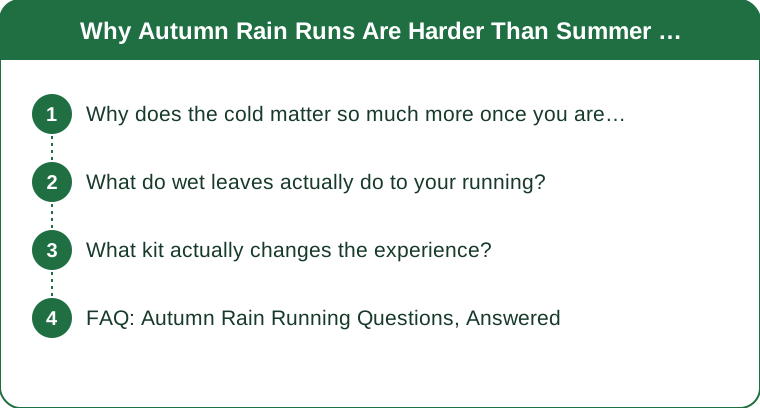
Why does the cold matter so much more once you are wet?
Because water changes how fast your body loses heat, by a large factor.
Water conducts heat away from the body far more effectively than air does, so a soaked layer is not a slightly worse insulator — it is a fundamentally different one. This is why 10°C and raining feels colder than 4°C and dry.
Wind multiplies it. Moving air strips the warm boundary layer from wet fabric continuously, and running generates its own headwind on top of any actual wind.
Your heat production drops as soon as the pace does. A run that starts brisk and slows on wet ground produces less heat exactly when the conditions demand more, which is the specific mechanism behind getting cold mid-run rather than at the end.
And the extremities go first. Blood flow to hands and feet is reduced to protect core temperature, so cold, clumsy hands are one of the earliest signals rather than a minor comfort issue.
The threshold is lower than people expect. Cold rain becomes a genuine consideration well above freezing — the combination of wet, wind, and reduced pace does more than the thermometer suggests.
What do wet leaves actually do to your running?
They change your stride, and the change costs energy.
Wet leaves on tarmac substantially reduce available friction, and the body responds automatically by shortening stride and increasing cadence to keep the foot closer under the centre of mass.
A shorter stride at the same pace requires more steps, and the constant micro-adjustments to uncertain footing recruit stabilising muscles that are not usually working this hard.
The result is a higher energy cost at the same speed. Running on unstable or slippery surfaces has a measurably higher metabolic cost than running on firm dry ground — the effort you feel is real, not psychological.
Ankles and calves take the extra load. Slippery surfaces increase the demand on the ankle stabilisers, which is why calves are often sore after an autumn run in a way they are not after a summer one at the same pace.
And hidden hazards multiply. Leaves cover potholes, kerb edges, and painted road markings, which are themselves far more slippery when wet. Painted lines and metal covers are the two most common slip points and both disappear under leaf cover.
The reasonable response is to accept the pace penalty. Running the same pace on wet leaves means running with less margin for error, and the injury risk is where that margin used to be.

What kit actually changes the experience?
One layer matters far more than the rest.
A wind-resistant shell over a wicking base is the core of it. Wind is what turns wet into cold, and a light windproof blocks it while letting some moisture out. A fully waterproof jacket often makes things worse in a run — it traps sweat, and you end up wet from the inside instead.
Avoid cotton entirely. Cotton absorbs many times its weight in water and holds it against the skin. A cotton t-shirt under a jacket is the single worst common kit choice in cold rain.
A cap with a brim outperforms a hood. A brim keeps rain out of the eyes, which is the main thing that ruins the experience, and a hood restricts hearing and peripheral vision on wet roads where you need both.
Gloves matter more than they seem to. Hands lose dexterity and comfort quickly in cold rain, and thin gloves cost nothing to carry. They are the item people most regret not bringing.
Shoes are a trade-off, not a solution. Waterproof shoes keep water out until water gets in over the top, and then keep it in. For rain running, a well-draining mesh shoe with good grip usually beats a waterproof one, and a trail outsole is genuinely useful on wet leaves.
Visibility becomes a safety item. Rain reduces driver visibility considerably and autumn afternoons are dark early. Reflective material on the ankles and wrists is far more effective than a static patch, because movement is what catches the eye.
FAQ: Autumn Rain Running Questions, Answered
Should I slow down deliberately in the rain?
Yes, and treat it as correct rather than as a compromise. A slower pace on wet leaves preserves the safety margin that the surface removed, and the effort is higher at that slower pace anyway. Judge the run by effort or heart rate rather than by pace — comparing a wet autumn run to a dry summer one on pace alone produces a demoralising and meaningless number.
How do I stop getting cold on the way home?
Change the base layer immediately, before anything else. Wet fabric conducts heat away fast, and heat production stops the moment you stop running. The first five minutes after finishing is the whole window — a dry top in a bag, changed in the car park, prevents almost all of it.
Is running in cold rain bad for you?
Not for a healthy adult with reasonable kit and sensible duration. The genuine risks are slips on wet surfaces and getting cold on a long run where you cannot warm up again. Very long runs in cold rain deserve real planning, and turning back is the right call if you start shivering. If you have a heart or circulatory condition, discuss cold-weather exercise with your doctor — this is general information, not medical advice.
What about my shoes afterwards?
Remove the insoles, stuff them with newspaper, and dry away from direct heat. A radiator or a hot air source can damage the midsole foam and the adhesives, shortening the shoe’s life considerably. Rotating two pairs through autumn means each gets 48 hours to dry properly, which is genuinely worth it if you run in the rain often.
TL;DR:
- Water conducts heat away from the body far faster than air, so wet kit in autumn cools you rapidly.
- Wet leaves reduce grip, shorten your stride, and raise the energy cost of the same pace.
- A wind-resistant shell over a wicking base beats a fully waterproof jacket for running.
- A brimmed cap beats a hood, thin gloves are the most-regretted omission, and draining shoes beat waterproof ones.
- Judge the run by effort, not pace, and accept the slower pace as correct.
- Change the base layer within five minutes of finishing, before anything else.
Dress for the wind rather than the water, slow down on the leaves, and autumn rain runs go back to being good ones.
Keep Reading
This article is for general informational and styling purposes only. Fit, sizing, and product availability may vary.