Why Your Socks Decide How a Rain Run Ends
Quick Answer: Blisters form from friction against skin that has been softened by moisture, and in the rain your foot is guaranteed to be wet - so the sock’s job is not to keep water out but to manage the water that is definitely there. Cotton holds water, loses all structure when saturated, and bunches, which is why it produces blisters reliably. Wool and synthetic blends keep their shape wet, wick continuously, and maintain a stable interface. Fit matters as much as fibre: a sock that shifts when wet will blister you regardless of what it is made of.
You cannot keep your feet dry in the rain. You can decide how wet feet behave.
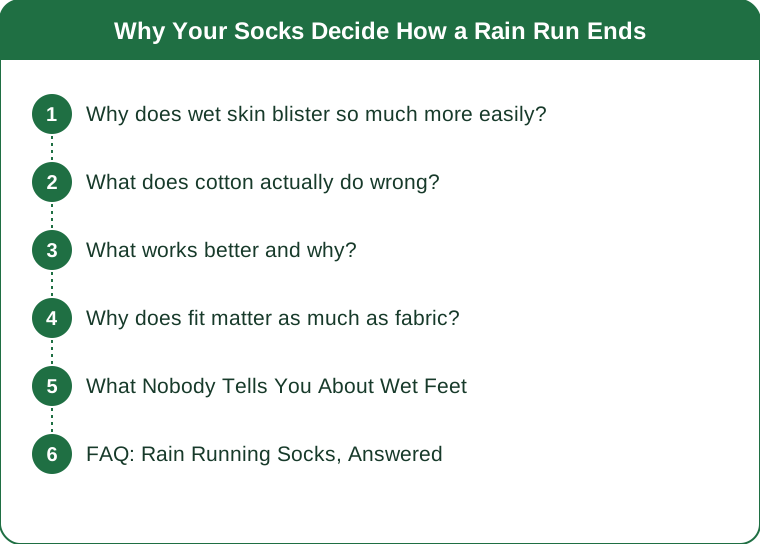
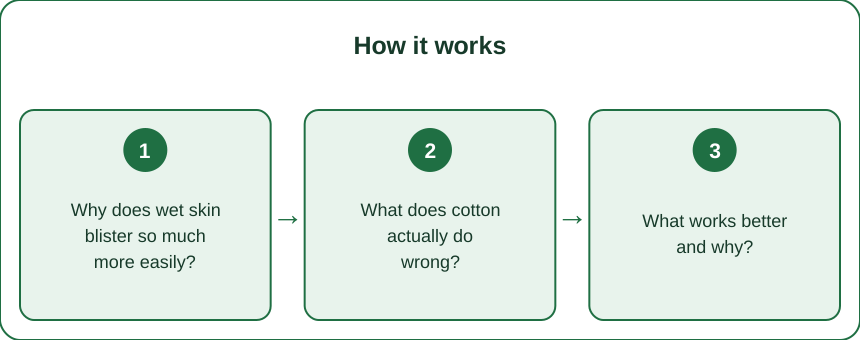
Why does wet skin blister so much more easily?
Moisture softens the outer layer of skin, which reduces its resistance to shear force.
Blisters come from shear, not from rubbing in the everyday sense - layers of skin sliding against each other separate and fill with fluid.
Wet skin has a higher friction coefficient than either dry or fully saturated skin, and damp is the worst of the three states.
This is why a light drizzle can be worse than a downpour - the foot sits in the damp zone rather than passing through it.
Warm wet is worse than cold wet because the skin is softer and more pliable, which is why warm autumn rain produces more blisters than cold winter rain.
And blisters form over kilometres, not moments. By the time you feel a hot spot the damage has been accumulating for a while, which is why stopping to address it early is so effective.
What does cotton actually do wrong?
It absorbs and holds water rather than moving it, so it stays saturated for the whole run.
Saturated cotton loses its structure, stretching and bunching in exactly the places you do not want a fold.
A fold in a wet sock is a concentrated shear point, and it is the direct mechanical cause of a large share of rain-run blisters.
It also holds cold against the skin through evaporative loss, which is why cotton socks make a cool run feel far colder at the feet.
It takes far longer to dry afterwards, which matters for anyone running consecutive days.
And it is often what people have most of, which is why this is the single most common and most fixable rain-run mistake.
What works better and why?
Merino wool keeps its structure when wet and continues wicking, and it retains some insulating value while saturated.
Synthetic blends - polyester, nylon, with some elastane - dry fastest and hold their shape well, and they are usually cheaper.
Blends of wool and synthetic get most of both, and are what most dedicated running socks actually are.
Waterproof socks exist and are genuinely waterproof, but they trap sweat inside, so they suit cold wet conditions and are poor in warm rain.
Toe socks suit people who blister between the toes specifically, by removing skin-on-skin contact where the shear happens.
And double-layer socks work by moving the shear into the sock itself rather than at the skin, which is a genuinely different mechanism from fibre choice.
Why does fit matter as much as fabric?
A sock that fits when dry can be loose when wet, since fibres relax and stretch under water.
Any looseness translates directly into movement, and movement against softened skin is the whole blister mechanism.
Heel cup shape is the most important fit feature - a sock that slips at the heel produces the most common rain blister location.
Anatomical left and right socks fit better than symmetric ones, which sounds like marketing and shows up clearly in wet conditions.
Sock thickness has to match the shoe. A thicker sock in a snug shoe compresses the foot; a thin sock in a roomy shoe lets the foot move.
And wet shoes stretch slightly too, which means the whole shoe-sock system is looser at kilometre ten than it was at kilometre one - the reason blisters cluster in the second half of a wet run.
What Nobody Tells You About Wet Feet
Lubricant beats powder in the rain. Powder cakes when wet and becomes an abrasive; an anti-chafe balm keeps working while soaked.
Lacing changes more than most people expect. A heel-lock lacing pattern reduces heel movement substantially and costs nothing.
Drainage matters. Shoes with mesh uppers let water out; water-resistant uppers let water in over the collar and then hold it.
Waterproof shoes are usually the wrong choice for running rain for exactly this reason - they work in puddles and fail in sustained rain.
Stopping for thirty seconds at the first hot spot prevents most blisters, and almost nobody does it because it feels like giving up time.
Change socks immediately afterwards, since the softening continues while the wet sock stays on and post-run is when a lot of damage completes.
And dry shoes properly - newspaper or a boot dryer, never direct heat, which damages the midsole and shortens the shoe’s life considerably.
FAQ: Rain Running Socks, Answered
What socks should I wear for running in the rain?
Merino or a wool-synthetic blend, snug fitting with a defined heel cup. Never cotton.
Are waterproof socks worth it?
In cold wet conditions, often yes. In warm rain they trap sweat and end up as wet as the alternative.
Should I use powder or balm?
Balm. Powder cakes when wet and turns abrasive, which is the opposite of what you want.
Why do I only blister on long wet runs?
Time under shear. Softened skin plus a sock and shoe that both loosen as they saturate, which is why blisters cluster in the second half.
Do waterproof shoes help?
Usually not for running. Water enters over the collar and cannot drain, so a draining mesh shoe is generally better.
How do I dry my shoes?
Remove insoles, stuff with newspaper, and dry at room temperature or with a dedicated dryer. Never on a radiator or with a heat gun.
TL;DR:
- Blisters come from shear against moisture-softened skin, so the sock’s job is managing water rather than excluding it.
- Cotton holds water, loses structure, and bunches - the folds are the direct mechanical cause of most rain blisters.
- Merino, synthetic blends, and double-layer socks all keep their shape wet; waterproof socks suit cold rain and fail in warm rain.
- Fit loosens as everything saturates, which is why blisters cluster in the second half of a wet run - heel-lock lacing helps.
- Use balm rather than powder, stop for thirty seconds at the first hot spot, and change socks the moment you finish.
Draining mesh shoes beat waterproof ones in sustained rain. Water gets in over the collar either way; only one lets it out.
Keep Reading
This article is for general informational and styling purposes only. Fit, sizing, and product availability may vary.