Why Your Rain Run Gear Fails in Warm Rain and Works in Cold
Quick Answer: A waterproof jacket fails in warm rain because your sweat rate exceeds the fabric’s ability to move vapour out. Waterproof membranes work on a humidity gradient, and in warm humid conditions that gradient nearly disappears — so you get soaked from the inside regardless of the rating. In warm rain, the better answer is usually no jacket at all, or a light water-resistant windshell, and choosing kit that performs wet rather than kit that stays dry.
In January, the jacket is the difference between a good run and a bad one.
In August, ten minutes in, you are wetter inside the jacket than you would be without it.
The jacket is not faulty. It is being asked to do something physically impossible.

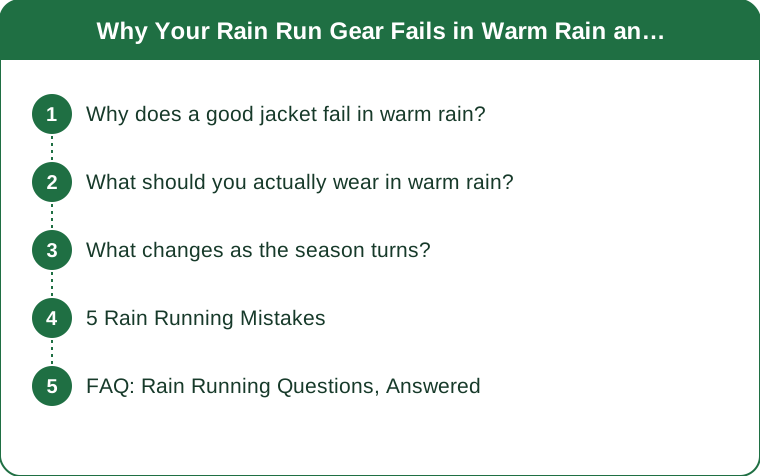
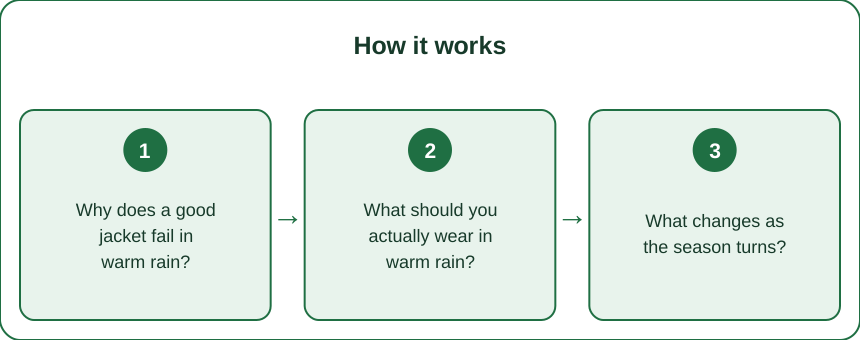
Why does a good jacket fail in warm rain?
Because the physics that makes a membrane work stops being available.
Membranes need a humidity gradient. Moisture vapour moves from the humid inside to the drier outside. In warm rain, the outside air is already near saturation, so there is almost nowhere for it to go.
Sweat rate is much higher in warm conditions. You produce far more vapour exactly when the fabric can move the least. The two curves work against each other perfectly.
Breathability ratings are lab figures. They are measured under a specific temperature and humidity differential that a warm rainy day does not remotely resemble.
Wetting-out blocks the outer face. When the outer fabric saturates, vapour transfer drops sharply even if the membrane is fine. This is why an old jacket with worn-off DWR feels far worse.
More waterproof usually means less breathable. The two properties trade off directly, so a highly waterproof shell is the wrong tool for warm rain by design.
And the result is measurable: on a warm humid run, many people end up wetter inside a fully waterproof shell than they would have been in the rain.
What should you actually wear in warm rain?
The counterintuitive answer is: less.
Often nothing waterproof at all. In temperatures above roughly 15C, getting wet is not a problem provided you keep moving. Rain is only dangerous when you stop.
A light water-resistant windshell if there is wind. Wind plus wet is what makes you cold, not wet alone. A 60g shell handles this without the vapour problem.
Choose fabrics that perform wet. Light synthetics and merino stay functional wet; cotton becomes heavy, cold and abrasive.
A cap with a brim is the highest-value item. Keeping rain out of your eyes improves a wet run more than any jacket.
Deal with chafing before you go. Wet fabric plus repeated movement is the classic chafe scenario. Anti-chafe balm on the usual points is the single most useful preparation.
Have dry kit ready at the finish. The whole risk in warm-rain running is the cooling that begins the moment you stop, not the run itself.

What changes as the season turns?
The thresholds shift quickly at this time of year, and most people update their kit too late.
Around 15C is the rough dividing line. Above it, a jacket is usually counterproductive; below it, it starts earning its place.
Wind moves the line upward. A windy 17C in rain feels like a still 10C. Wind chill is the variable that decides, not temperature.
Duration matters more than distance. A 25-minute run in warm rain is fine unprotected. Two hours is a different question entirely.
Autumn rain is colder than it looks. Early autumn showers are noticeably cooler than summer ones, and the same clothing decision that worked in July can leave you cold in September.
Visibility drops before temperature does. Wet roads plus early dusk arrives in September, and reflective kit becomes relevant before the jacket does.
And shoes need reconsidering. Wet leaves on tarmac are genuinely slippery. Grip matters more from now on than it has all summer.
5 Rain Running Mistakes
Wearing the winter jacket in summer rain. The single most common error, and it makes the run worse rather than better.
Skipping anti-chafe. Wet running is where chafing happens, and it is entirely preventable in thirty seconds.
Cotton anything. Wet cotton holds water, weighs several times its dry weight, and abrades skin. This includes socks, where it causes blisters reliably.
Standing around afterwards. The cooling starts immediately and quickly. Get changed within five to ten minutes.
Neglecting the shoes afterwards. Newspaper inside and air drying away from direct heat. Heat degrades adhesives and warps the midsole.
And the one that catches people out: running the same route without thinking about surfaces. Painted road markings, metal covers and wet leaves all become considerably more slippery, and that is where wet-weather falls happen.
FAQ: Rain Running Questions, Answered
Is it bad to run in the rain?
No, provided you are dressed for the temperature and change promptly afterwards. Wet alone is not the risk; wet and stationary is.
What temperature do I need a waterproof jacket?
Roughly below 15C, and sooner if it is windy. Above that, a jacket usually makes you wetter than the rain does.
How do I stop my shoes squelching?
You do not, really. Thin synthetic or merino socks and accepting wet feet works better than trying to keep them dry.
Will running in rain make me ill?
Being wet does not cause infection. Getting chilled afterwards is unpleasant and worth avoiding, which is what the dry change kit is for.
How should I dry my shoes?
Remove insoles, stuff with newspaper, dry at room temperature. Never on a radiator — heat damages the midsole and adhesives.
Do I need waterproof socks?
They work for some people and cause blisters for others. Most experienced wet-weather runners simply accept wet feet and change afterwards.
This is general information, not medical advice.
TL;DR:
- Waterproof jackets fail in warm rain because membranes need a humidity gradient that warm humid air removes.
- Above roughly 15C, no jacket is usually the better choice; below it, or in wind, one earns its place.
- Choose kit that performs wet — synthetics and merino — and never cotton.
- A brimmed cap and anti-chafe balm improve a wet run more than any shell.
- The real risk is cooling after you stop: have dry kit ready and change within ten minutes.
Next warm shower, leave the jacket at home and take a cap instead. Most people never go back.
Keep Reading
This article is for general informational and styling purposes only. Fit, sizing, and product availability may vary.