Why the First Rain Run of the Season Feels Worse Than Any Winter One
Quick Answer: Late-summer rain arrives on warm humid air, so you get soaked while your body is still acclimatised to summer heat and dressed for it. High humidity blocks sweat evaporation at the same time, so you overheat and get wet simultaneously, which is a combination that does not occur in winter. You also have no seasonal habits yet: no kit ready, no route adjustment, no expectation. Winter rain is colder and far easier because everything about you is set up for it.
You got caught out, you were uncomfortable in a way that did not match the temperature, and you know for a fact you will run in worse in three months and feel fine.
This blog has covered why rain runs feel colder at the end than the start and why your heart rate reads high in the rain. This is the specifically seasonal version, and it is the one that catches people every year.

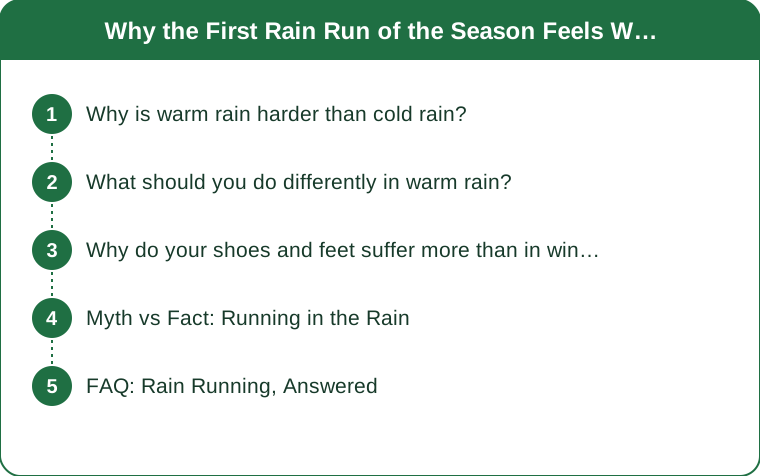
Why is warm rain harder than cold rain?
Because it removes your cooling system while adding water.
Rain in late summer usually comes with very high humidity. Sweat cools you only when it evaporates, and evaporation slows dramatically as the air approaches saturation. In heavy humidity, sweat runs off you doing nothing.
So you overheat while soaking wet, which feels contradictory and is real. Your core temperature rises because you cannot dump heat, while your skin is wet and cool. Your body is receiving two conflicting signals.
You are dressed for summer, which means minimal fabric that holds water badly. A cotton or light synthetic summer top saturates quickly, adds weight, and chafes. Winter kit is chosen to handle exactly this.
Your acclimatisation is set for dry heat. Weeks of summer running have adapted you to sweat efficiently in conditions where sweat evaporates. Humid conditions render that adaptation ineffective, which is why a humid run feels far harder than a hotter dry one.
Heart rate runs high for the same reason. Your body sends more blood to the skin to try to cool you, which reduces what is available to your muscles, so your heart rate climbs at the same pace. This is a real physiological effect and it makes pace-based judgements misleading.
Winter rain avoids most of this. Cold air is dry, evaporation works, and you have the right kit. It is more unpleasant to start and considerably easier to run in.
What should you do differently in warm rain?
Adjust expectations first, then kit, then route.
Slow down and run by effort. Pace will be slower for the same effort, and forcing your usual pace in humidity is how a run becomes miserable. Treat it as an easy day.
Wear less, not more. The instinct in rain is to add a jacket. In warm humid rain, a jacket traps heat and moisture and makes overheating worse. A light technical top that will get wet is better than a shell that keeps rain out and sweat in.
Choose fabrics that handle saturation. A close-fitting technical top chafes far less when soaked than a loose cotton one. Anything cotton, including underwear and socks, is the wrong choice.
Deal with chafing before you leave, not after. Wet fabric plus movement is the classic combination, and anti-chafe balm on the usual spots takes 20 seconds and prevents the thing that ruins the following two days.
Wear a cap with a brim. Rain in your eyes is the single most degrading factor in an otherwise fine run, and a brim solves it completely for very little weight.
Adjust the route for standing water and traffic. Drivers see less, road markings disappear, and puddles hide potholes. Late-summer storms drop a lot of water quickly onto ground that has been dry, so runoff is worse than the same rainfall in autumn.
And change immediately when you finish. This is the point where warm rain turns into a cold problem, and it is covered properly in the post-run change piece on this blog.

Why do your shoes and feet suffer more than in winter?
Because warm wet feet behave differently from cold wet feet.
Wet skin is softer and far more vulnerable to friction. Blisters form much faster on wet feet, and warm wet feet swell more than cold ones, changing how your shoe fits mid-run.
Summer socks are usually thinner. Less cushioning under wet conditions means more direct friction, at exactly the moment your skin can handle it least.
Shoes take a long time to dry and you probably only have one pair in rotation. Running in still-damp shoes the following day is worse than the original wet run, and it is where most repeated blister problems come from.
Dry shoes with newspaper or a fan, never with direct heat. A radiator or a hairdryer degrades adhesives and distorts foam. Remove the insoles, stuff loosely with newspaper, and leave them somewhere with airflow.
Two pairs in rotation is the real answer if you run regularly through wet seasons. It also extends the life of both, because midsole foam recovers between runs.
And check your feet afterwards. Warm wet conditions are also when fungal problems become likely. Drying thoroughly between the toes and not leaving damp socks on after a run handles most of it. This is general information, not medical advice, and anything persistent is worth getting looked at.
Myth vs Fact: Running in the Rain
Myth: You need a waterproof jacket to run in the rain. Fact: In warm rain a jacket usually makes things worse, trapping heat and sweat. In cold rain, a light windproof layer is genuinely useful, mostly for stopping wind chill rather than water.
Myth: You will get ill from running in the rain. Fact: Being wet does not cause infection. Getting properly chilled afterwards while standing around in wet kit is the part worth avoiding, and it is a comfort and recovery issue.
Myth: Rain makes running harder. Fact: Cool rain frequently makes it easier, because it helps you dump heat. Humid warm rain makes it harder, and people remember the second and generalise from it.
Myth: Your heart rate reading high in the rain means you are working harder. Fact: In humidity, more blood goes to your skin for cooling, so heart rate rises at the same effort. The number is real and it does not mean the same thing as it does on a dry day.
Myth: You should skip a run if it is raining. Fact: The unpleasant part is almost entirely the first two minutes. Once you are wet, you are wet, and most runners report the run itself being fine. The genuinely worth-skipping conditions are lightning, ice, and flooded routes.
Myth: Wet shoes should be dried on a radiator. Fact: Direct heat degrades midsole foam and adhesives and shortens the shoe’s life considerably. Newspaper and airflow, insoles removed.
FAQ: Rain Running, Answered
Why does running in warm rain feel so much harder than cold rain?
High humidity prevents sweat from evaporating, so you cannot shed heat while also being soaked. Cold rain comes with dry air where evaporation still works, so cooling is not impaired.
What should I wear for a warm rain run?
Less than you think. A close-fitting technical top, no cotton anywhere including socks, a cap with a brim, and anti-chafe balm. A waterproof jacket usually traps more sweat than it keeps out rain.
How do I dry running shoes properly?
Remove the insoles, stuff them loosely with newspaper, and leave them somewhere with airflow. Avoid radiators and hairdryers, which degrade the foam and adhesives.
TL;DR:
- Late-summer rain comes with humidity that blocks sweat evaporation, so you overheat and get soaked at the same time.
- Run by effort rather than pace, wear less rather than more, and skip the waterproof jacket in warm rain.
- Anti-chafe balm and a brimmed cap solve the two things most likely to ruin the run.
- Dry shoes with newspaper and airflow, never direct heat, and rotate two pairs if you run through wet seasons.
By November the same weather will feel routine. The problem is not the rain, it is that nothing about your setup is ready for it yet.
Keep Reading
This article is for general informational and styling purposes only. Fit, sizing, and product availability may vary.