Why Warm Rain Runs Are Trickier Than Cold Ones
Quick Answer: In warm rain, your sweat cannot evaporate because the air is already saturated, so you overheat while soaking wet — the opposite of the cold-rain problem. That combination of high skin moisture and continued sweating is what causes the chafing and blisters warm rain is notorious for. Dress lighter than instinct suggests, lubricate before you leave, and expect your pace to be slower at the same effort.
Cold rain you know how to handle: layers, a hat, get changed fast. Warm rain feels easier and then produces a genuinely rough run — hotter than expected, chafed in new places, and slower than the effort felt.
Warm rain is a heat problem disguised as a wet problem. Nearly all standard rain advice is written for the cold version and points you the wrong way here.
Here is what changes and how to run it well.

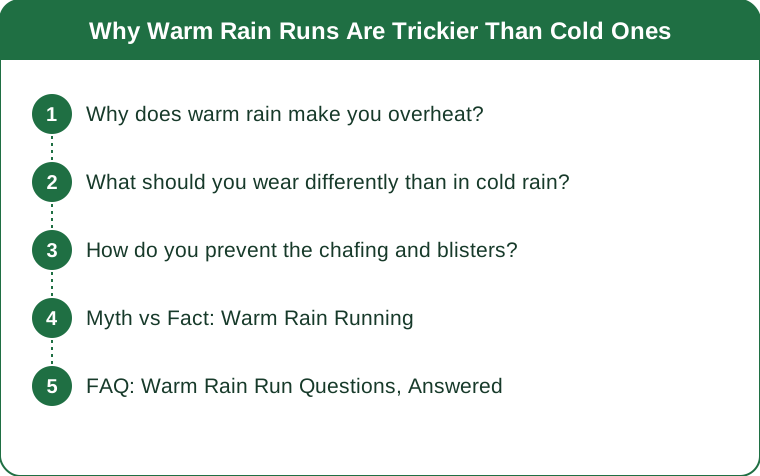
Why does warm rain make you overheat?
Because your primary cooling system — sweat evaporating — stops working in saturated air.
Evaporation needs somewhere to go. Sweat cools you by evaporating. When relative humidity approaches 100%, as it does during warm rain, the air cannot accept more moisture, so sweat runs off you instead of evaporating. You lose the cooling and keep the fluid loss.
The rain itself does cool you a little. Rain on your skin removes some heat directly, which is why warm rain feels pleasant for the first mile. It is real but much smaller than the evaporative cooling you have lost.
So your heart rate drifts upward. At the same pace, expect a higher heart rate and a higher perceived effort. Run to effort, not to pace, and accept 20 to 40 seconds per mile slower for the same work.
Hydration still matters. People drink less in rain because they do not feel thirsty and their skin is wet. You are still sweating, and often sweating more than usual.
What should you wear differently than in cold rain?
Less, and specifically not a jacket.
Skip the rain jacket entirely. In warm rain a jacket traps heat and humidity against you, which makes both the overheating and the chafing worse. You are getting wet either way; choose to get wet without a sauna on top.
Choose the lightest, thinnest layers you own. A thin singlet or crop and lightweight shorts. Heavier fabrics hold water, gain significant weight, and increase friction — the three things you are trying to avoid.
Avoid cotton absolutely. Cotton holds many times its weight in water and becomes an abrasive once saturated. This is the single most common cause of a badly chafed warm-rain run.
Wear a brimmed cap. Not for warmth — to keep rain out of your eyes. It is the one piece of gear that genuinely improves a warm rain run.
Reconsider your socks. Thin, snug, synthetic or wool socks. Thick socks hold water, bunch, and cause blisters. Wool handles wet better than most synthetics.

How do you prevent the chafing and blisters?
Lubricate before you leave, and manage the friction points that only appear when wet.
Apply lubricant to everything that touches. Inner thighs, under the sports bra band and straps, underarms, and the waistband line. Do it before you get wet — applying to wet skin does not work.
Wet fabric is more abrasive, not less. Saturated fabric grips skin and stiffens slightly. Seams that are invisible on a dry run become the problem after 30 minutes of warm rain.
Blisters come from wet feet plus movement, not from the water alone. Snug shoes, thin socks, and lubricant or tape on known hotspots. A shoe that fits well dry will loosen slightly wet, which allows the sliding that causes blisters.
Shorten the run if it is your first wet one. Chafing is progressive and it is much better discovered at 3 miles than at 10.
Deal with it immediately afterward. Wet gear off, rinse, dry thoroughly. Skin that stays wet for an hour after the run is what turns mild chafing into something that hurts for three days.
Myth vs Fact: Warm Rain Running
Myth: Rain means you should dress warmer. Fact: in warm rain, dressing warmer is the primary mistake. The risk is overheating, not chilling — that flips only when air temperature drops below roughly 60°F.
Myth: A waterproof jacket keeps you dry. Fact: in a warm downpour you end up equally wet from the inside. Jackets are for wind and cold, not for warm rain.
Myth: You sweat less in the rain. Fact: you often sweat more, because your cooling is impaired. You simply cannot tell, which is why hydration gets neglected.
Myth: Wet shoes will be ruined. Fact: they are fine if you dry them properly — remove insoles, stuff with newspaper, and dry at room temperature. Direct heat is what actually damages them.
Myth: You should slow down because it is slippery. Fact: slow down because your effort is higher. Traction matters on painted lines, metal, and wet leaves specifically; open wet pavement is not especially slippery.
FAQ: Warm Rain Run Questions, Answered
Is there a temperature where the advice flips?
Roughly 60°F, and it depends on wind. Above that, treat rain as a heat-management problem. Below it, especially with wind, the chilling risk becomes real and layering advice applies again.
Should I run in a downpour or wait it out?
Steady warm rain is fine and often pleasant. Wait out thunderstorms without exception, and be cautious of the first ten minutes of heavy rain, when road oil lifts and surfaces are at their most slippery.
How do I dry my shoes fast enough to run tomorrow?
Remove the insoles, loosen the laces fully, stuff with newspaper, and put them somewhere with moving air at room temperature. Change the newspaper after two hours. Never use a radiator, a dryer, or direct sun — heat degrades the midsole and the adhesives.
This is general information, not medical advice.
TL;DR:
- Warm rain saturates the air, so sweat cannot evaporate and you overheat while soaking wet.
- Expect a higher heart rate and 20 to 40 seconds per mile slower at the same effort — run to effort.
- Wear less, not more, and skip the rain jacket entirely above about 60°F.
- No cotton. Thin synthetic or wool layers and socks, plus a brimmed cap.
- Lubricate thighs, bra lines, underarms, and waistband before you leave — wet fabric is more abrasive, not less.
- Get out of wet gear immediately afterward and dry shoes with air, never heat.
Warm rain gets treated as a milder version of cold rain when it is actually a different problem entirely. Dress for the heat you cannot shed, protect the friction points, and late-summer rain runs become some of the best of the year.
Keep Reading
This article is for general informational and styling purposes only. Fit, sizing, and product availability may vary.