How to Dry Running Shoes Overnight Without Wrecking Them
Quick Answer: Heat is the one thing a wet running shoe cannot afford: radiators, heat vents, and clothes dryers soften adhesives, accelerate midsole foam aging, and warp uppers. What actually dries a shoe is moving air plus an absorption gradient — insoles out, laces loosened wide, a first hour stuffed with paper that gets swapped once, then open airflow from a fan overnight. That protocol takes a soaked pair to wearable by morning and fully dry in a day, costs nothing, and shortens nothing’s lifespan.
The deeper fix is a two-pair rotation, which turns drying from an emergency into a background process.

Why does heat wreck a wet shoe?
Because a running shoe is a laminated foam sandwich held together by glue, and every layer hates heat.
The adhesives go first. Modern uppers are largely bonded, not stitched, and midsoles attach to outsoles and uppers with heat-activated cements. A radiator top or heat vent can sit well above the softening range of those bonds — which is why chronically radiator-dried shoes delaminate at the toe cap and sidewalls months before their mileage would justify it.
The foam ages in fast-forward. Midsole EVA loses its resilience through heat cycles; warm-dried foam stiffens and packs down sooner, which you feel as a shoe that has gone dead early. The cushioning you paid for is a temperature-sensitive component being treated like laundry.
The upper shrinks and warps. Wet textiles and synthetic leathers dried fast and hot contract unevenly, pulling at overlays and changing the fit in exactly the places blisters come from. Heel counters — the stiff cup that locates your heel — can distort permanently.
The clothes dryer adds tumbling impact to all of the above, which is why it is the single worst option available, mesh bag or not.
Meanwhile the thing heat is supposedly providing — speed — is mostly delivered by air movement anyway. Evaporation scales with airflow and with the dryness of the surrounding air far more efficiently than with surface temperature, at the temperatures a home offers. A fan on cool air outdries a radiator, and charges you nothing for it. The radiator is not a fast method with a cost. It is a slow method with a cost.
What actually moves water out of a shoe?
Three mechanisms, and the protocol just stacks them in order.
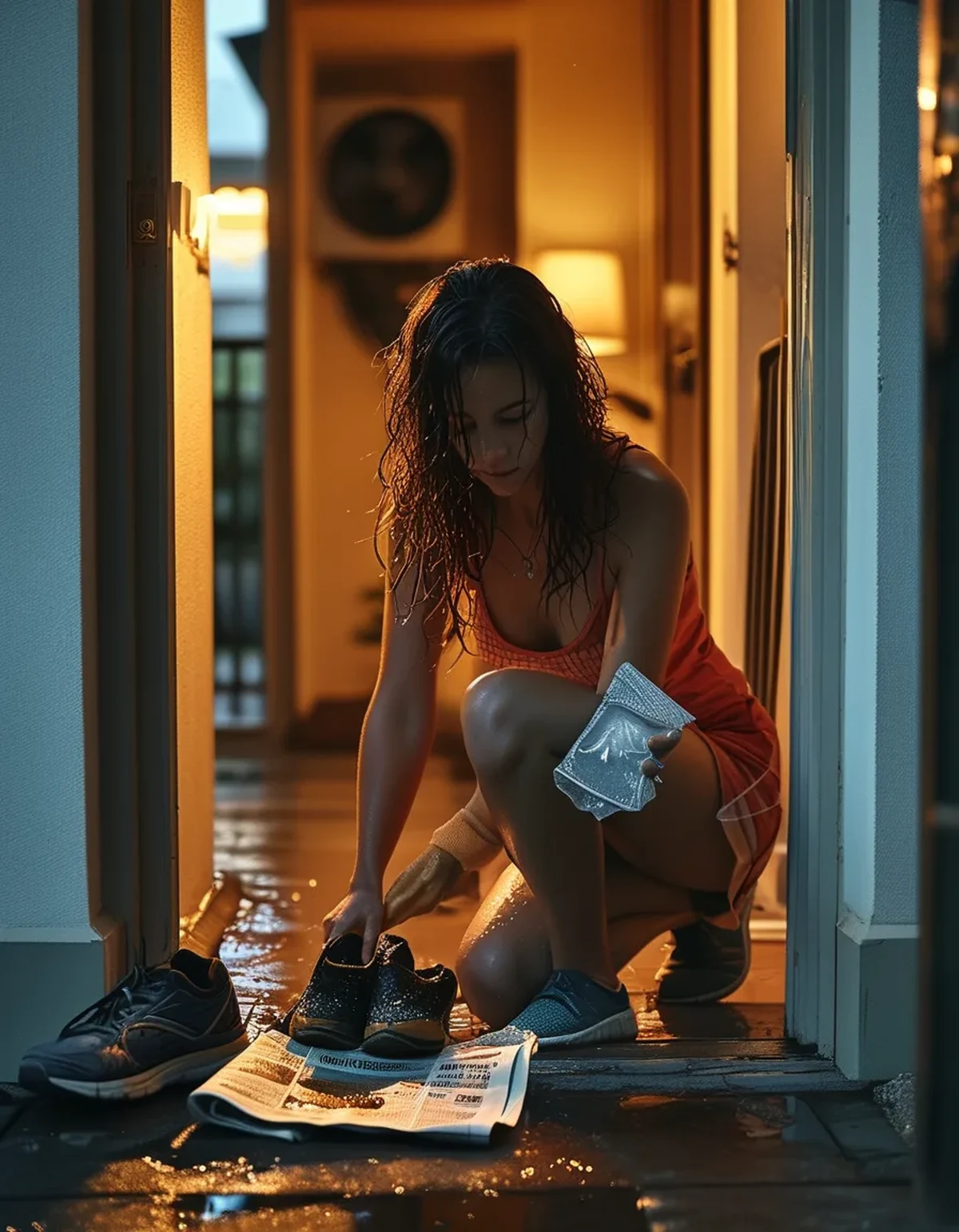
Absorption handles the first, wettest hour. A soaked shoe holds standing water in the footbed cavity and saturated foam; the fastest way to move that first volume is contact with something drier. Crumpled newspaper or paper towels stuffed firmly into the toe box and cavity wick hard — and here is the part everyone skips: the paper does most of its work in the first 45 to 60 minutes and then sits there saturated, slowing everything down. One swap after the first hour, then remove paper entirely for the night. Wet paper left in until morning is why people think the trick is overrated.
Airflow handles the long middle. After the standing water is gone, drying is evaporation from foam and fabric, and evaporation lives on air exchange — saturated air must keep leaving the shoe’s interior. A small fan aimed into the openings transforms the rate; pointing the shoes mouth-first toward the fan, tongues pulled fully open, matters more than any gadget.
Geometry handles the leftovers. Water pools at the lowest point, so orientation decides where the damp patch survives. Propped at an angle, heel down and mouth toward the fan, lets gravity feed the airflow. Insoles — removed at minute zero, always — dry separately in a fraction of the time and give the fan access to the footbed, which is otherwise the last wet place.
Insoles out, laces loosened to the last eyelet, paper hour, swap, fan overnight: wearable by morning after all but the most biblical soakings.
5 Drying Methods, Ranked
One: fan plus the paper hour — the standard. Free, overnight, zero material cost to the shoe. Everything else on this list is measured against it.
Two: a boot dryer on its no-heat or low setting. Convection dryers that gently move air up through the shoe work well and hands-free; the caution is that some models run hotter than their marketing admits. If the airstream feels more than faintly warm at the port, it is a slow radiator. Unheated forced-air models are the category done right.
Three: the rice bin — the overrated folk remedy. Rice does absorb moisture, slowly, from the small volume of air touching it; a shoe buried in rice dries somewhat faster than a shoe on the floor and much slower than a shoe in front of a fan. You also inherit starch dust in the mesh and grains in the toe box. It is not wrong. It is just worse than free moving air.
Four: the radiator, heat vent, or sunny dashboard — the slow poison. It works, visibly, which is why people trust it, and it ages glue and foam every single time. Occasional emergencies survive it; a rainy-season habit of it takes months off a pair’s life. Direct summer sun adds UV yellowing to the bill.
Five: the clothes dryer — the executioner. Heat plus tumbling plus banging. One desperate cycle can visibly ripple a midsole or start a delamination. There is no version of this that the shoe wins.
The pattern: everything that adds heat subtracts lifespan. Everything that adds airflow is free speed.
The wet-season routine that makes it automatic
A permanent entryway station and three habits, assembled once.
The station: a spot by the door with a small fan, a stack of newspaper or a bag of paper towels, and somewhere to prop shoes mouth-open — a boot rack, a crate edge, anything angled. The routine only survives if it takes ninety seconds while you are still dripping.
Habit one — deal with them immediately. Shoes that sit soaked in a bag or by the door seal in the water and start the smell clock: damp foam is exactly the warm, wet habitat odor bacteria want, and a shoe that spends a night saturated often smells musty for weeks after. Rinse off mud first — a wet shoe rinses clean effortlessly, a dried-mud shoe never fully does — then insoles out, laces open, paper in.
Habit two — swap the paper once, then trust the fan. Set a timer for the first swap; after that the fan owns the night. Socks and running tights, meanwhile, are the easy part of the equation — technical fabrics wring out and dry on a hanger in a couple of hours, which is precisely why the shoes, not the leggings, are the bottleneck your routine has to solve.
Habit three — rotate two pairs. With a second pair in the rotation, no run ever starts in yesterday’s damp shoes, drying can take its full gentle day, and — the quiet bonus — both pairs’ midsoles get recovery time between loadings, which is worth real mileage. The rotation converts every drying emergency this article solves into a non-event.
Rainy-season postscript: stuff a spare grocery bag in your running belt or jacket pocket. The runs that soak shoes are rarely the ones you planned for — the bag gets wet gear home without marinating the rest of yours.
FAQ: Wet Shoe Questions, Answered
Newspaper or paper towels — does it matter?
Barely. Newsprint is absorbent, free, and mildly prone to ink transfer on white interiors; paper towels absorb slightly faster and cost slightly more. The swap-after-an-hour habit matters ten times more than the paper species.
Are heated boot dryers categorically bad, then?
No — gentle forced-air models that run barely warm are excellent and safer than any radiator. The test is your hand at the port: comfortable indefinitely means fine, noticeably hot means it is trading shoe life for speed. No-heat convection towers pass automatically.
How do I handle soaked shoes at the office after a rain commute?
Insoles out and both parts under the desk with whatever airflow exists — even a folder propped as a vent helps. Skip the radiator under the window, accept damp-but-wearable by evening, and let the real protocol run at home overnight.
When has a shoe been wet too many times?
Water itself is not the killer — heat and neglect are. A pair that gets rinsed, fan-dried, and rotated survives a wet season structurally fine; retirement remains a mileage-and-foam question. The tell-tale of water mistreatment is peeling bonds and a musty smell that laundering cannot fix, and both trace to heat and sitting wet, not to rain.
TL;DR:
- Heat is the one forbidden input: radiators, vents, sun, and dryers soften adhesives, age midsole foam, and warp uppers.
- Drying is absorption then airflow: insoles out, laces wide, one paper hour with a single swap, then a fan overnight — wearable by morning.
- Method ranking: fan first, no-heat boot dryer second, rice a distant third, radiator and clothes dryer never.
- Deal with wet shoes in the first five minutes, rinse mud while wet, and run a two-pair rotation so drying is never urgent.
Build the entryway station this week — fan, paper, prop. The next storm run ends with a ninety-second ritual instead of a moldy Tuesday surprise.
Keep Reading
This article is for general informational and styling purposes only. Fit, sizing, and product availability may vary.